

Travel Notes
Valentine’s Day: A Global Celebration of Love

Jan
In Brief: What is Valentine’s Day?
- Valentine’s Day is celebrated on February 14th as a tribute to love. Each year, it accounts for over $15 billion in global spending, a testament to its deep cultural and social significance.
- Its roots reach back into antiquity, weaving together the story of Saint Valentine—a 3rd-century Christian martyr—and ancient Roman rites.
- Today, it is observed across the globe as a moment to express affection through symbolic gestures, such as a bouquet of flowers or a unique piece of jewelry
- Each year, it accounts for over $15 billion in global spending, a testament to its deep cultural and social significance.





Valentine’s Day: At a Glance
| Element | Key Information |
|---|---|
| Date | February 14th |
| Origin | Christian legends and ancient Roman traditions |
| Meaning | Celebration of love and devotion |
| Global Reach | Worldwide (or nearly so) |
| Symbols | Hearts, roses, chocolates, and fine jewelry |
| Popularity | Celebrated by approximately 60% of couples |
| Economic Impact | Over $15 billion annually |
On February 14th, nearly 60% of couples will celebrate their bond. But have you ever wondered why we chose this specific day? Where does this tradition, so popular across so many borders, truly come from? And finally, what do you offer when inspiration runs dry? I will endeavor to answer these questions.

What is the true story behind Valentine’s Day?
Disclaimer: No one knows the true origin of Valentine’s Day with absolute certainty. Several versions exist, blending ancient Christian traditions and Roman heritage. What makes this story even more mysterious is that we don’t even know if it refers to one person or two different figures bearing the same name! (Indeed, countries like Spain, Italy, Ireland, and the Czech Republic all claim to house the authentic relics of Saint Valentine—over 10 European churches claim to be the guardians of his remains!).
Let us explore the legends that shaped this day:
Let us explore the legends that shaped this day:

The Courageous Priest in 3rd-Century Rome
Imagine Ancient Rome in the 3rd century AD. Emperor Claudius II rules with an iron fist and has just made a radical decision: he forbids young soldiers from marrying. His reasoning? Single men, without the distraction of wives or children, would make better warriors, more focused on the heat of battle.
Enter Valentine, a priest living in Rome. Finding this decree profoundly unjust, he decided to defy the ban. In secret, within the shadows of the catacombs, he continued to perform marriages for young lovers who refused to renounce their union.
But as you might imagine, his secret did not stay hidden for long. When Claudius II discovered these clandestine weddings, he first ordered Valentine’s imprisonment. Surprisingly, the Emperor considered granting him a pardon. Unfortunately, Valentine committed the unthinkable: he attempted to convert the Emperor to Christianity. Infuriated, Claudius II ordered his execution. According to legend, Valentine survived an initial stoning before being beheaded near the Flaminian Gate. The date most often cited for his martyrdom is February 14, 273 AD.
The Miracle of the Bishop of Terni
Another tradition tells a different, yet equally fascinating story. Here, Valentine is not a simple priest but the Bishop of Terni, a city in Umbria, Italy.
The story begins with Asterius, a Roman judge skeptical of Christianity. To test Valentine, he challenged him to heal his adopted daughter, who had been blind since birth. Valentine succeeded in restoring her sight, but then set his own conditions: he asked Asterius to destroy his pagan idols and be baptized within three days. Impressed by the miracle, the judge accepted and had his entire family baptized.
Alas, this conversion did not please Emperor Claudius. Valentine was arrested and sentenced to death, sealing his fate as a martyr. Another tragic end.
The Lupercalia: A Pagan Festival Reborn
There is a completely different theory that takes us even further back in time.
Long before Valentine’s Day existed, the Romans celebrated a festival in mid-February called the Lupercalia. Dedicated to the god Faunus (the Roman equivalent of the Greek god Pan), it was a celebration of fertility, the renewal of nature, and the coming of spring.
During the Lupercalia, priests known as Luperci performed sacred rituals on the Palatine Hill, including animal sacrifices. A rather visceral start for a celebration of lovers, wouldn’t you say? Yet, it stood as a cornerstone pagan festival in the Roman calendar
According to this version, the Catholic Church decided around the 5th century to suppress this pagan celebration and replace it with the commemoration of Saint Valentine.
The Poetic Legend of the Couple and the Rose
The most lyrical legend tells of Saint Valentine intervening in a heated argument between two lovers. While tending to the roses in his sanctuary, he overheard the couple quarreling. Rather than letting the dispute fester, he acted.
He plucked a rose, approached them, and asked them to listen. He offered the rose as a symbol of peace, blessing them. Love returned to their hearts, and shortly after, they returned to ask him to marry them. Thus, the rose became the ultimate emblem of love and reconciliation.

Valentine’s Day in Greece: A Modern Tradition
Let me tell you how Greece adopted this holiday, as it is quite a contemporary tale.
Contrary to what one might think, Valentine’s Day only began to gain popularity in Greece in the late 1970s. Because of the lack of reliable historical data on Valentine’s life, his feast day does not officially appear on the Orthodox calendar.
However, the Greeks did not simply import a foreign holiday; they sought to create their own:
In 1994: A proposal was made to celebrate lovers on July 3rd, the feast of Saint Hyacinth of Cappadocia. This young man died for his faith at only 20 years old.
In 2000: Archbishop Christodoulos proposed a celebration on February 13th, the day of Saints Aquila and Priscilla. This Jewish couple lived in Corinth, converted to Christianity, and are honored for their mutual devotion.
Today, even if the roots are not as deep as other Greek traditions, February 14th has become a cherished date for couples to express their gratitude for one another.

Valentine’s Day Around the World
In Slovakia: Imagine celebrating love twice a year! Slovaks honor lovers not only on February 14th but also on May 29th, the time when birds build their nests—a powerful symbol for couples.
In Finland: It is called “Ystävänpäivä,” or “Friendship Day.” I adore this broader vision of love, celebrating friends and family alike.
In Verona, Italy: Every year, about 1,000 letters are addressed to Juliet herself. Volunteers respond to these love notes from all over the world. So romantic!
In China: Long before Western traditions arrived, the Qixi festival existed: the night of the seventh day of the seventh moon. Known as the “Double Seventh Festival,” its date varies between mid-July and mid-August.
In South Korea: On February 14th, women give chocolate to men. On March 14th, the “White Day,” men return the gesture with white gifts—chocolates, pastries, or jewelry.
In Japan: There is even a “Black Day” on April 14th, where singles gather, dress in black, and eat black noodles (jjajangmyeon) to toast their freedom.
In India: Valentine’s Day is becoming increasingly popular, especially among young people, while others prefer to rely on traditional festivals of love and partnership, such as Karva Chauth (where women fast for their husband’s longevity) or Holi (the festival of colors, often associated with love and emotional rebirth). Here again, the symbolism is powerful: jewelry, finery, and colorful clothing—everything speaks of beauty and renewal
In the Maghreb: In countries like Tunisia, Morocco, Algeria, or Egypt, it is called “Aïd el hob” (the Feast of Love), also celebrated on February 14th.
Pets’ Valentine’s Day: Did you know that about 3% of people buy a gift for their pet? After all, who can resist the unconditional love of a dog or cat?

Valentine’s Day in Figures
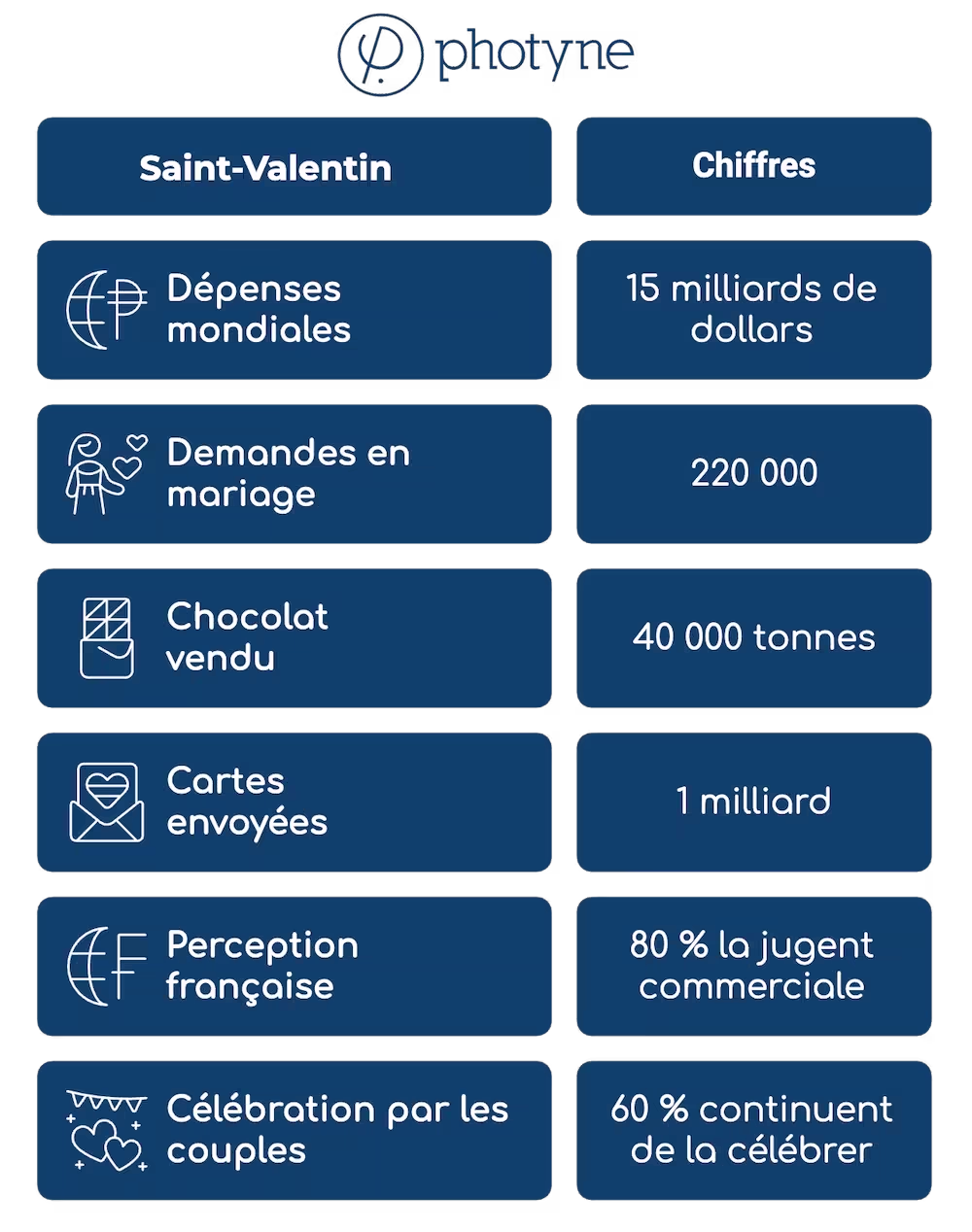
- $15 Billion: The total global spending related to the holiday.
- 220,000 Marriage Proposals: It is one of the most popular days to get down on one knee.
- 40,000 Tons of Chocolate: A staggering figure that would melt any heart.
- 1 Billion Cards: Sent globally, though many are now replaced by digital messages.
Gift Ideas: What to give for Valentine’s Day?
I love these “gifting” moments, even if I don’t wait for a calendar date to surprise my loved ones. Whether it’s a marketing event or not, follow your heart, always.
Fun fact: Nearly 80% of French people consider Valentine’s Day primarily a commercial holiday. Yet, 60% of couples continue to celebrate it, showing an assumed ritual of consumption around love.
Looking for inspiration ? Here are the most popular Valentine’s Day gifts in France
- Flowers : 25 %
- Perfume: 21 %
- Chocolates : 17 %
- Jewelry (16%)
- Apparel / accessories : 15 %
Jewelry are in the top 4 for Valentine’s day. Necklaces and rings lead the way, followed closely by earrings and… brooches, which are very trendy right now.

FAQ
What is the date of Valentine’s Day?
February 14th. Similar celebrations occur at other times, like Qixi in China or White Day in Japan.
Why is it celebrated on February 14th?
It traditionally corresponds to the date of Saint Valentine’s martyrdom. The Church likely chose it to replace certain Roman pagan festivals related to fertility.
Is it a commercial holiday?
For many, yes (80% of French people). Yet 60% still celebrate it, giving it a personal and symbolic meaning.
Is Valentine’s Day a religious holiday?
Originally linked to Christianity, it has become a largely cultural and social celebration, observed independently of religious practice.
What is the most gifted item?
Flowers take the lead, followed by perfume, chocolate, and jewelry. Jewelry accounts for 16% of purchase intentions, chosen for its symbolic and emotional value.
Should I give a gift on Valentine’s day ?
There are no rules. Some prefer a shared experience, others a symbolic object. Increasingly, personalized and artisanal gifts are favored for their emotional and lasting dimension.
Jewelry as unique as your love
Couples are increasingly choosing personalized, handcrafted gifts that are as authentic as their love. This is exactly what I offer with Photyne jewelry: not one piece among a thousand, but a unique promise. If you are looking for inspiration to spoil the one who makes your heart beat faster, you are in the right place.
If you are looking for inspiration to spoil the one who makes your heart beat faster, you are in the right place.
